Software development lifecycle
Learning outcomes
Learners ...
- understand what a software development phase is
- understand what a software development lifecycle is
- can name the two main categories of software development lifecycle models
- understand which software development phases the course uses
- understand which software development lifecycle models the course uses
- understand why the course uses Agile
- understand why the course needs you to be social
For teachers
Prior:
- What is meant by 'Software development phase?'
- Could you name some phases in software development?
- What is meant by 'Software development lifecycle?'
- Could you name some models of software development lifecycles?
- Does a programmer need social skills?
What is a software development lifecycle?
A way to develop software.
Why is it important?
Using the wrong software development lifecycle will
cost you more time and money [Aniley et al., 2024].
Software development phases
Software develops in phases. As there are multiple lists of these phases, here is a list from Wikipedia, with my description of each phase:
| Phase | Description |
|---|---|
| Conceptualization | Getting an idea |
| Requirements analysis | Develop an understanding of what is needed |
| Design | Create the architecture on how to realize this |
| Construction | Write the code |
| Acceptance | Make sure it is good enough |
| Deployment | Release the finished software |
| Maintenance | Keep the software running |
| Decommission | Archive or delete the software |
Software development lifecycles
The software development lifecycle is the way how you
transitions between phases.
There are many software development lifecycles.
Yas and colleagues collected the most important ones
and described the advantages and disadvantages of each
cycle [Yas et al., 2023].
Here I follow their primary grouping of development lifecycles,
following either a traditional or an Agile model [Yas et al., 2023]:
| Model | Description | Example | Overview |
|---|---|---|---|
| Tradition | Go through each phase once, do not go back | Waterfall | 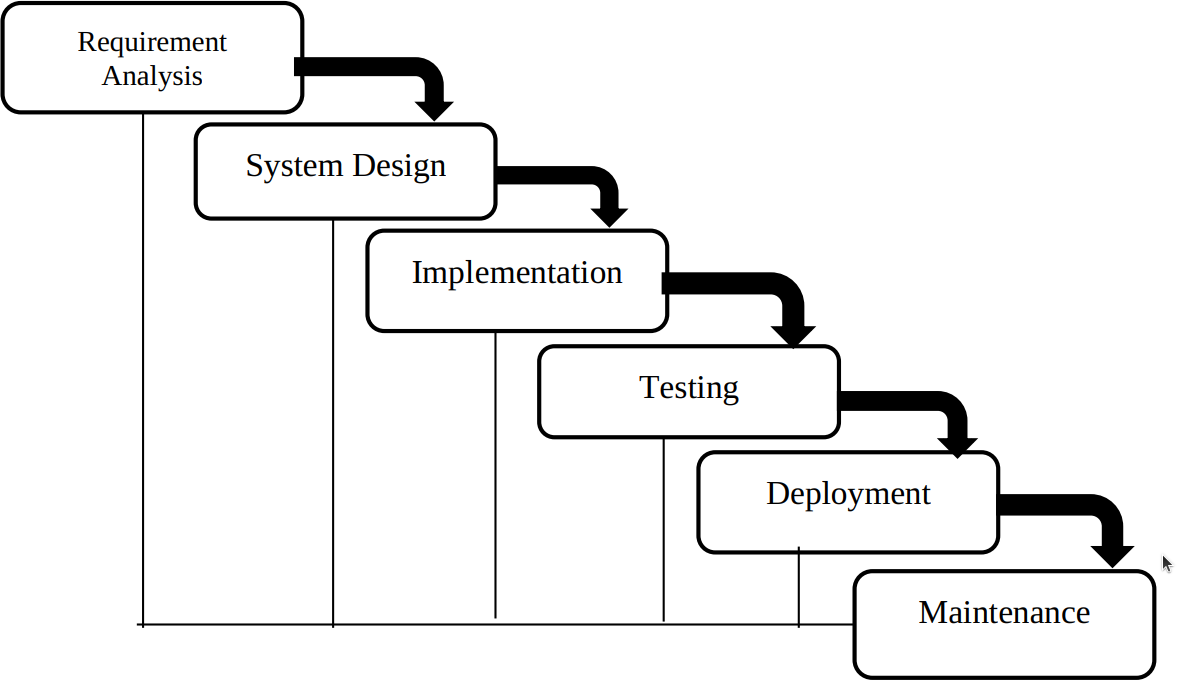 |
| Agile | Cycle through each of the phases often, in small changes | eXtreme Programming | 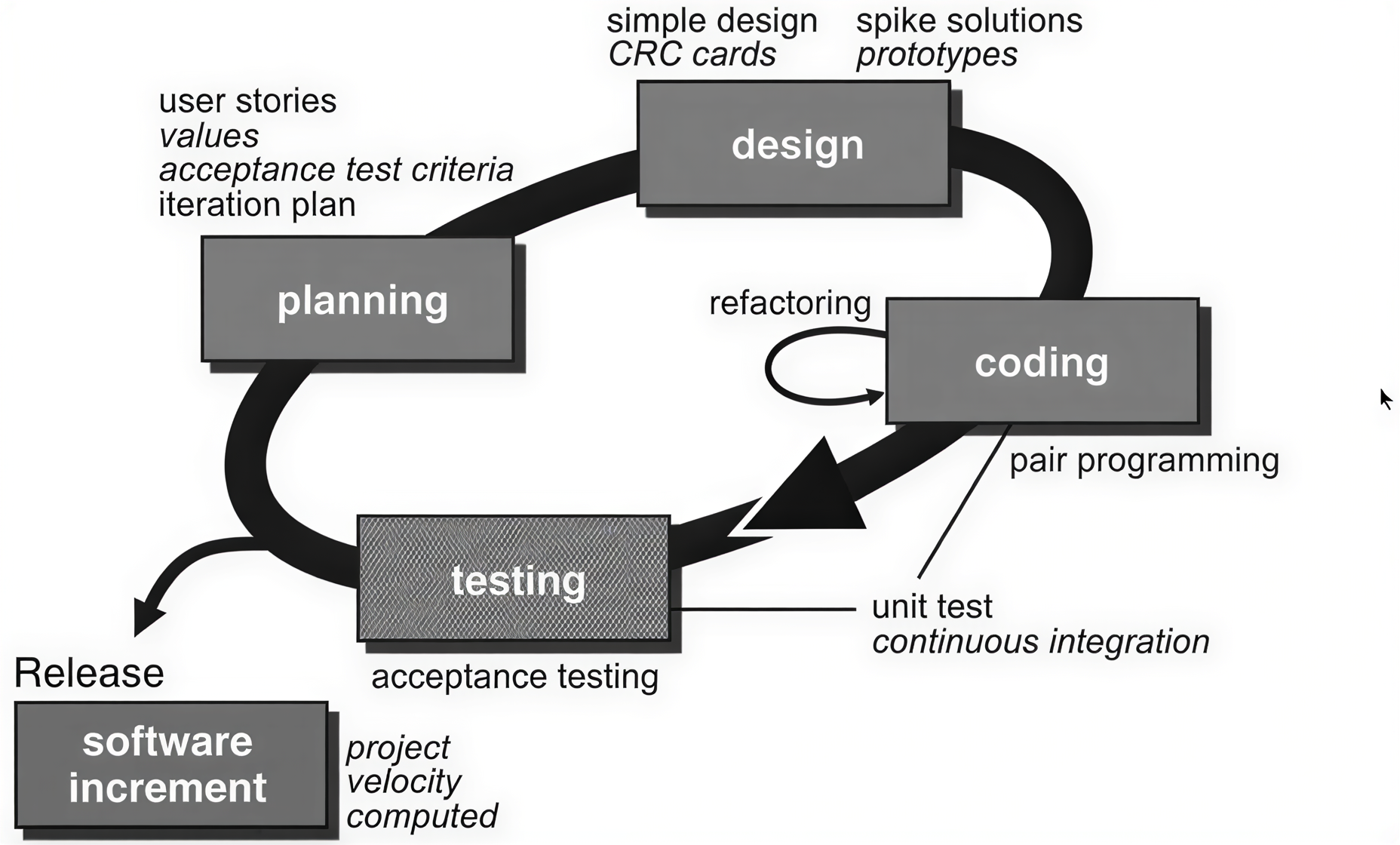 |
Note that a software development lifecycle does not need to be a cycle :-)
The same grouping is used by Leau and colleagues ,
where they gives a comparison of traditional
versus agile software development [Leau et al., 2012] (Table 1):
| Parameter | Agile | Traditional |
|---|---|---|
| User requirement | Iterative acquisition | Detailed user requirements are well-defined before coding/implementation |
| Rework cost | Low | High |
| Development direction | Readily changeable | Fixed |
| Testing | On every iteration | After coding phase completed |
| Customer involvement | High | Low |
| Extra quality required for developers | Interpersonal skills & basic business knowledge | Nothing in particular |
| Suitable Project scale | Low to medium-scaled | Large-scaled |
Why we follow the Agile software development model
The literature states:
- In follow-the-sun development, of all the best practices,
Agile is the one most often recommended
[Kroll et al., 2013] - Use Agile
[Aniley et al., 2024](although the paper does not describe where this recommendation is based on) - You should implement continuous delivery
[Forsgren et al., 2018] - You should use Agile, as software development cycles are 25% shorter
and project success rates increase by 18%
[Pastrana et al., 2025] - Use Continuous Integration
[Serban et al., 2020] - Use Continuous Integration
[Visser et al., 2016] - In scientific computing, make incremental changes
[Wilson et al., 2014] - In scientific computing, keep changes small
[Wilson et al., 2017] - Use Agile for small-medium project development, use traditional models for large-scale project
In this course, we mostly follow the Agile model.
Exercises
Exercise 1: which phases does the course use?
The course website clearly shows how we preferred to group the different software development phases. What are these?
Answer
You can see these at the top menu:

The phases are:
- Conceptualization
- Planning
- Design
- Development
- Deployment
It seems that the 'Testing' phase is missing. Does this course ignore testing? Tip: check the table of content of the 'Development' menu item.
Answer
No.
The 'Development' menu item shows some items with the word 'testing' in it.
This indicates that this course bundles development and testing into one phase.
Exercise 2: software development lifecycle does not need to be cycle?
In the text it is mentioned:
A software development lifecycle does not need to be a cycle :-)
What is meant by this?
Answer
It highlights that the traditional model is not a cycle at all.
Exercise 3: which lifecycle does the course use?
The course logo gives a hint at our software development life cycle.
What is it?
Answer
The course logo contains a circle, hinting at a cycle. Having (many) cycles is typical of an Agile software development lifecycle.
Exercise 4: what does the course lifecycle require of team members?
We use Agile as most (all?) literature recommends this for our project size. However, Agile has more demands on the team. What are these?
Answer
The team members need 'Interpersonal skills & basic business knowledge'.
It can be found in the table from [Leau et al., 2012] (Table 1):
| Parameter | Agile | Traditional |
|---|---|---|
| Extra quality required for developers | Interpersonal skills & basic business knowledge | Nothing in particular |
References
-
[Aniley et al., 2024]Aniley, D. Bitew, E. Alemneh Jalew, and G. Abeba Agegnehu. "Selection of software development life cycle models using machine learning approach." Int J Comput Appl 186 (2024): 36-43. -
[Forsgren et al., 2018]Forsgren, Nicole, Jez Humble, and Gene Kim. Accelerate: The science of lean software and devops: Building and scaling high performing technology organizations. IT Revolution, 2018. -
[Kroll et al., 2013]Kroll, Josiane, et al. "A systematic literature review of best practices and challenges in follow-the-sun software development." 2013 IEEE 8th International Conference on Global Software Engineering Workshops. IEEE, 2013. Paper homepage -
[Leau et al., 2012]Leau, Yu Beng, et al. "Software development life cycle AGILE vs traditional approaches." International Conference on Information and Network Technology. Vol. 37. No. 1. 2012. -
[Pastrana et al., 2025]Pastrana, Manuel, et al. "Best Practices Evidenced for Software Development Based on DevOps and Scrum: A Literature Review." Applied Sciences 15.10 (2025): 5421. Paper homepage -
[Serban et al., 2020]Serban, Alex, et al. "Adoption and effects of software engineering best practices in machine learning." Proceedings of the 14th ACM/IEEE International Symposium on Empirical Software Engineering and Measurement (ESEM). 2020. Paper homepage -
[Visser et al., 2016]Visser, Joost, et al. Building software teams: Ten best practices for effective software development. " O'Reilly Media, Inc.", 2016. -
[Yas et al., 2023]Yas, Qahtan M., Abdulbasit Alazzawi, and Bahbibi Rahmatullah. "A comprehensive review of software development life cycle methodologies: Pros, cons, and future directions." Iraqi Journal for Computer Science and Mathematics 4.4 (2023): 14. -
[Wilson et al., 2014]Wilson, Greg, et al. "Best practices for scientific computing." PLoS biology 12.1 (2014): e1001745. Paper homepage -
[Wilson et al., 2017]Wilson, Greg, et al. "Good enough practices in scientific computing." PLoS computational biology 13.6 (2017): e1005510. Paper homepage